
13 Questions to Ask Before Buying a Bag Machine
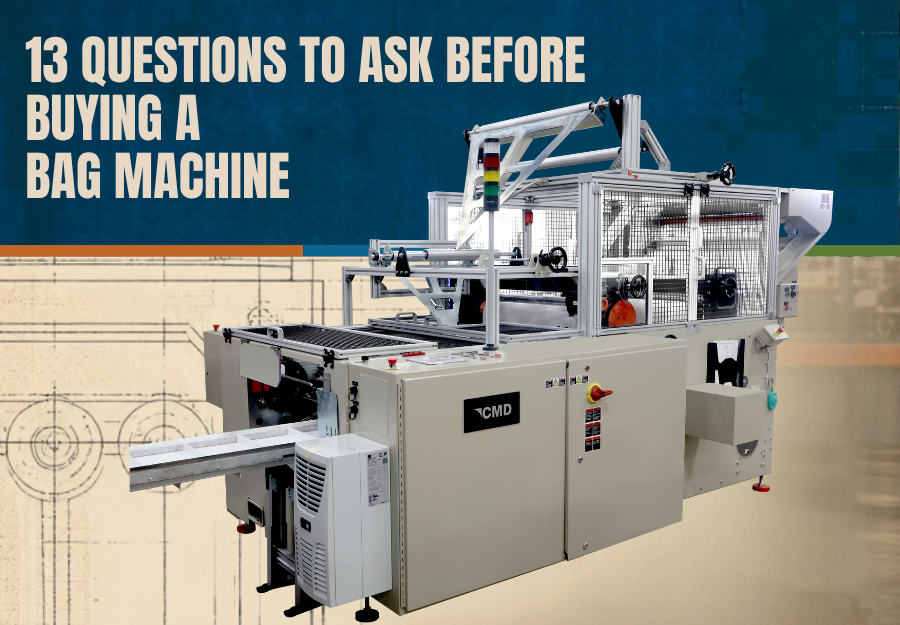
A practical guide for procurement, engineering, and operations teams evaluating bagmaking equipment
Choosing the wrong bag machine costs more than the initial purchase price. It can lead to lost production time, excess material waste, difficult changeovers, and limited flexibility as customer requirements evolve.
Before signing a purchase order, procurement, engineering, and operations teams should evaluate how well the equipment fits their current production needs, future plans, workforce, and existing converting operation. These 13 questions will help your team compare bagmaking equipment based on real operating requirements, not specifications alone.
CMD Corporation has spent more than four decades helping converters work through this evaluation. The questions below reflect the production, support, and lifecycle considerations that can determine whether a machine delivers long-term value.
Key Takeaways Before Buying a Bag Machine
- Define your bag formats, materials, dimensions, and throughput requirements before comparing equipment.
- Verify production claims with your materials and production conditions rather than relying on rated line speed alone.
- Evaluate changeover time, operator requirements, equipment integration, and future flexibility.
- Compare service, training, parts availability, maintenance, and total cost of ownership—not only purchase price.
- Document acceptance criteria before the machine is built so both parties share a clear definition of success.
Why the Right Questions Matter
A bag machine is a long-term capital investment. It influences what you can produce, how efficiently you can change between products, how much labor and floor space your operation requires, and how readily you can respond to future market demands.
Rated speed and purchase price matter, but they do not tell you whether a machine will handle your film structures, consistently meet your quality standards, integrate with existing equipment, or be supported when production is interrupted. A structured evaluation brings those issues forward while they can still be addressed.
PMMI’s 2026 Packaging State of the Industry Report highlights flexibility, automation, and changing production demands as important forces in the packaging machinery market. Those trends make it even more important to select equipment that fits both today’s operation and tomorrow’s requirements.
Questions About Your Products and Production Requirements
1. What types of bags do you produce today?
Start with a factual inventory of your current products. Identify whether you produce bottom-seal, star-seal, drawtape, T-shirt, gusseted, food, freezer, garbage, or other specialty bags.
Include the products that account for most of your volume as well as lower-volume jobs that create difficult setups or frequent changes. This gives the equipment supplier a realistic view of the work the machine must perform.
2. What film materials and structures must the machine handle?
Document the materials you currently run, including LDPE, HDPE, LLDPE, post-consumer recycled content, biodegradable materials, blends, laminates, and any specialty structures relevant to your operation.
Material behavior can vary considerably. Share representative samples and specifications so the supplier can evaluate sealing, web handling, tension control, cutting, perforating, and winding requirements before recommending a configuration.
3. What bag sizes, gauges, and formats are required?
List the minimum and maximum web widths, bag lengths, film gauges, lane configurations, fold requirements, seal types, perforation patterns, and winding formats you expect to run.
Do not rely only on broad product categories. Two products described as trash bags may require very different web handling, sealing, folding, and winding capabilities. Specific ranges help prevent a mismatch between the quoted machine and your actual product mix.
4. What might your operation need to produce next?
Consider the products, materials, and output levels your business may need during the machine’s expected operating life. Customer specifications, sustainability goals, retailer requirements, and new market opportunities can all change your production mix.
Ask whether the proposed equipment can accommodate new formats, thinner gauges, higher recycled content, additional lanes, or increased throughput. A flexible platform can reduce the risk of an unplanned capital purchase when your market changes.
Questions About Performance and Daily Operation
5. What output can the machine sustain under real operating conditions?
Rated line speed is a useful reference point, but it is not the same as finished, saleable output. Ask for expected production rates using your film, bag dimensions, lane configuration, quality requirements, and winding or packaging method.
Discuss sustained performance across a full production shift—not only the peak speed reached during a short demonstration. Film variation, product changes, operator experience, and downstream equipment all affect actual throughput.
6. How will the supplier verify its production claims?
Ask for production data from comparable applications and request a test using your material whenever practical. A trial at the manufacturer’s facility can reveal how the equipment handles your film and provide time to evaluate product quality, setup, controls, and actual output.
Before testing begins, agree on measurable acceptance criteria such as speed, seal quality, dimensional tolerances, scrap level, uptime, and finished-roll requirements. Documenting these expectations gives both teams a shared definition of success.
7. How long will product and material changeovers take?
Every changeover stops production. Ask the supplier to explain each setup step, identify which adjustments are manual, and estimate the time required for the changes your team performs most often.
Features such as stored recipes, automatic positioning, quick-adjust tooling, and intuitive controls may reduce setup time and operator error. Evaluate changeover performance using your actual product mix rather than a single ideal demonstration.
8. What operator skills and training will be required?
A machine should fit the capabilities of the workforce expected to run and maintain it. Review the control interface, setup process, troubleshooting tools, maintenance access, alarm information, and documentation with operators and maintenance personnel—not only management.
Confirm what training is included at installation, how many people can participate, whether refresher or advanced training is available, and what digital or printed resources remain available after startup.
9. How will the machine integrate with your existing operation?
Evaluate the full production flow, including upstream film supply, downstream winding or packaging, material handling, quality inspection, production data, and plant systems. A machine that performs well independently may still create bottlenecks if the surrounding process is not considered.
Confirm communication requirements, line controls, guarding interfaces, web direction, operator access, roll or product discharge, and responsibility for integration. Clearly defining the scope early helps prevent gaps between equipment suppliers.
10. What facility, safety, and utility requirements must be addressed?
Confirm the equipment footprint as well as the working space needed for operation, maintenance, material loading, roll removal, guarding, and safe access. Review ceiling height, floor loading, installation route, and any foundation or anchoring requirements.
Document electrical power, compressed air, ventilation, network connectivity, environmental conditions, and applicable safety or regulatory requirements. Understanding these needs early makes budgeting and installation planning more accurate.
Questions About Support and Lifetime Value
11. What support is available after installation?
Ask what happens after startup and final acceptance. Technical support availability, remote diagnostics, field-service coverage, response procedures, and escalation paths all influence how quickly production can recover when an issue occurs.
Confirm whether technicians are trained on the specific machine platform and whether the supplier supports both mechanical and controls-related issues. If response time is critical, ask the supplier to explain how urgent service requests are prioritized.
- Is technical support available outside normal business hours?
- Can technicians securely diagnose problems remotely?
- Where are field-service technicians located?
- What information should your team provide when requesting service?
12. How readily available are replacement parts and maintenance resources?
Ask which components are considered critical spares, where they are stocked, and what lead times are typical. Confirm whether the manufacturer supplies OEM parts, recommended spare-parts packages, preventive-maintenance schedules, maintenance kits, and upgrade support.
Also review component accessibility and routine service tasks with your maintenance team. A machine that is easier to inspect and maintain can help reduce service time and support more consistent performance over its operating life.
13. What is the machine’s total cost of ownership?
The purchase price is only one part of the investment. Compare the costs and operational effects of installation, utilities, labor, training, changeovers, scrap, preventive maintenance, replacement parts, planned downtime, service, and future upgrades.
Evaluate those costs alongside expected saleable output, product flexibility, equipment life, and support. The lowest initial price does not necessarily produce the lowest cost per bag or the strongest return over the machine’s full lifecycle.
Warning Signs During Equipment Partner Evaluation
Pay attention to how a potential supplier responds to detailed operational questions. Vague answers about material compatibility, output, changeovers, integration, service response, or parts availability may indicate that important requirements have not been fully evaluated.
- The supplier cannot identify installations running products or materials comparable to yours.
- Performance claims are based only on maximum rated speed and are not tied to your application.
- The machine cannot be demonstrated under production-realistic conditions.
- Acceptance criteria and responsibility for integration are not clearly documented.
- Parts availability, service coverage, or response procedures are difficult to verify.
- Training is limited to initial installation, with no plan for future employees or refresher instruction.
A credible equipment partner should welcome detailed questions and support its recommendations with application knowledge, test results, references, and a clearly defined scope.
How CMD Helps You Evaluate Machine Fit
CMD approaches equipment selection as a collaborative evaluation. Our team works with procurement, engineering, operations, maintenance, and production stakeholders to define the bag formats, materials, output targets, integration needs, and support requirements that should guide the machine configuration.
CMD and FAS Converting provide a broad portfolio of bagmaking and winding solutions supported by application engineering, testing, installation, training, OEM parts, remote diagnostics, preventive-maintenance resources, and global service capabilities. CMD also provides 24/7 service support for urgent equipment needs.
The objective is not simply to quote a machine. It is to identify a solution that fits your production today, supports your workforce, and gives your operation room to adapt.
Ready to evaluate your next bagmaking system? Contact CMD to begin a machine-fit consultation.
Contact Sales